Placebo is a term that you’ve probably heard before, probably because of the placebo effect, but do you really know much about it? A placebo plays a huge role in clinical trials and, more specifically, how our medications, medical devices, treatments, and vaccines get to us. Let’s talk a little bit about the role that placebos play and why they are important.
Understanding What a Clinical Trial Is
Before jumping into the importance of placebos in clinical trials, it’s crucial to understand what a clinical trial is. A clinical trial is a research study that involves human research volunteers. For the most part, these trials are done to evaluate the medical treatments, devices, medications, and vaccines, that are used on patients. These products are being tested for their effectiveness or whether or not they work.
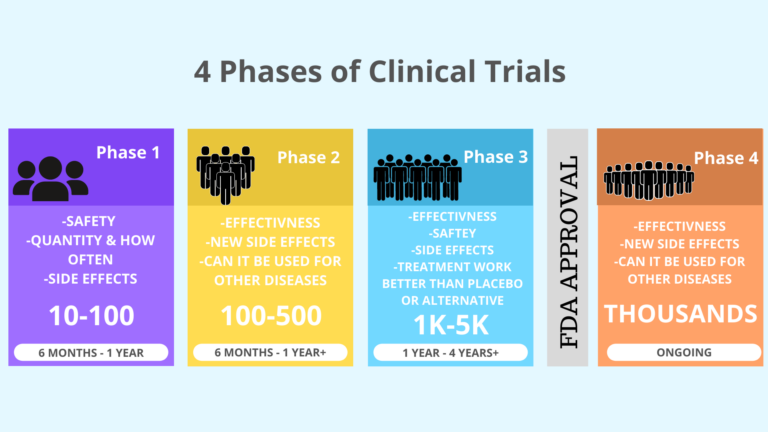
There are 4 phases of a clinical trial, and all 4 stages are important. A more extensive explanation of what happens in each phase is in one of our other blogs, so take the time to check it out. (Should You Sign Up For A Clinical Trial) Just to give you a summary, all the phases take about 6 months to 4 years to complete, and each has a specific population of volunteers.
Usually, there are 2 (sometimes more) groups of people, volunteers who are actually getting the researched treatment and others who are getting the placebo. The point of the clinical trial is to compare these two groups, look at the data, and decide if the real treatment is effective and safe for use. This is the “golden standard” of clinical trials. In addition, there is no bias, the clinical trial is diverse, and everything is randomized.
Lastly, there is a list of questions that each phase must answer. One of the questions that need to be answered in phase 3 is “does the treatment work better than the placebo?” There is a reason this question is asked, and now we are going to get into the cause.
What is a Placebo, And What Is Its Importance?
A placebo is defined as an inactive substance. It looks like the treatment or drug being researched but truly does nothing good or bad to the patient. So, what does this mean? It means that volunteers are taking a drug that may or may not be doing anything to them. With this, they have the opportunity to tell the truth as to how their body is actually reacting. So, the question “does the actual drug being tested work better than the placebo” is a crucial question.
It’s important that the researchers pay attention to every detail and don’t leave anything out. This is why there is a placebo involved in the process. They take the time to examine the data to see the difference between those taking the placebo and those taking the actual treatment. If there is even the slightest doubt or the results show that the treatment is ineffective or isn’t safe, then they need to go back a step and try again. This is done through medical measurements, testing, and asking patients what differences they are feeling (if they have any).
Ways of Completing Clinical Trials With A Placebo
There are a couple of ways that a clinical trial can be conducted. We have placebo-controlled, double-blind, and open-label.
Placebo-controlled is where one group gets the actual treatment, and the other gets the placebo. Other than that, all the other variables are the same. If there is any change, researchers know it is because of the real treatment.
Double-Blind is where no one knows who is getting the actual treatment or the placebo; this also includes the researchers. Another group not involved in the study assigns volunteers to their groups and keeps track of the data. Once the trial is completed, the blindness is broken, and the patients get to know which treatment they received.
Open-Label is pretty straightforward. Both the researchers and the volunteers know what treatment they are getting. This gives the volunteers the opportunity to be truthful when it comes to any surveys they take.

What About The Placebo Effect?
The placebo effect is when a volunteer starts to “feel an effect” of their treatment. They believe that the placebo is working, but the reality is that this is just in their mind. The mind truly is a powerful tool. This specific instance has shown up in trials before, but researchers know that the volunteer has taken the placebo, and it’s just a case of the placebo effect.
So, Do We Really Need Them?
There is a debate in the medical industry about whether we really need placebos. Some say there are other ways to get the same result as a placebo. Others are saying that placebos work to protect society from unsafe and ineffective treatments. The reality is that there are rules and regulations put in place to ensure that placebos do not harm volunteers and can be helpful in research, as we have been discussing. In addition, volunteers know there is a possibility of getting the placebo and have already agreed to the process.
So, as of right now, we really do need them. This process has led to the approval and use of many treatments on the counter and prescribed at a doctor’s office. Let’s not take the placebo for granted and appreciate it for where it has gotten the medical industry.

Resources
Disclaimer: This blog provides general information and discussions about health-related topics. If you or any other person has a medical concern, you should consult your health care provider and seek professional medical treatment. Some of the information and content in this blog has linked materials. The links should and are not intended to be construed as medical advice and should not be supplemented as medical advice. If you think you may have a medical emergency, locate emergency services or dial 911.